


The Real Reasons Students Struggle with the ATI TEAS
After teaching nursing students for over 14 years, the most common reasons students fail the ATI TEAS 7 are severe test anxiety, poor time management, and relying on rote memorization instead of conceptual application. To pass the TEAS, students must shift from passive reading to practicing active critical thinking under strict timed conditions.
Hi, I’m Nurse Cheung. I am an MSN, RN, and I have been teaching the ATI TEAS and preparing students for nursing school for a decade. Over the years, I have looked at thousands of TEAS score reports, and I need to tell you a secret that the test prep industry doesn’t want you to know:
Students do not fail the TEAS because they aren’t smart enough for nursing school. They fail because their study tactics are completely broken. If you have failed the TEAS (or if you are terrified of failing your first attempt), take a deep breath. You are smart enough to be a nurse. You just need to stop falling into these four specific psychological and tactical traps.
Reason 1: The Pacing Panic (Time Management)
The ATI TEAS 7 is a brutally timed exam. One of the most common reasons a brilliant student fails is because they refuse to guess.
You will encounter a highly complex math question, panic, and stare at it for four solid minutes trying to force the answer. Because you wasted that time, the clock runs out, and you are forced to leave the last 10 questions of the section completely blank.
The Fix: You must learn to guess and move on. The TEAS does not penalize you for wrong answers, but a blank answer is a guaranteed zero. If you don’t know the math formula within 30 seconds, pick your favorite letter, flag the question, and keep moving.
Reason 2: The Flashcard Trap (Rote Memorization)
This is the number one reason students fail the Science section. You can sit at your desk and memorize 500 individual vocabulary definitions on flashcards, but if you don’t know how those definitions actually interact within the body, you will fail.
The TEAS doesn’t just ask you to define a vein; it asks you to apply critical thinking to the entire cardiovascular system.
The Fix: Stop relying on passive rote memorization. You need to use visual, systemic flowcharts to understand how the body’s systems connect to one another. You need to map the concepts, not just memorize the words.
Reason 3: Second-Guessing (The Answer Change)
Let me drop an educator truth bomb on you: when a student goes back at the end of a section and changes their initial answer, they change it from right to wrong roughly 70% of the time.
Test anxiety makes you doubt yourself. You will talk yourself out of the correct answer simply because a different option “looks trickier.”
The Fix: Trust your gut instinct. Your brain recognized the correct pattern the first time for a reason. Unless you suddenly remember a specific, concrete fact that proves your first answer was wrong, absolutely do not change it.
Reason 4: Studying Fluff
Thousands of students fail simply because they give up halfway through their studying. They buy a 500-page, heavy traditional textbook, sit down to study, and get so overwhelmed by the sheer volume of useless information by page 40 that they close the book and never open it again.
The Fix: You need micro-learning and targeted review. Stop studying fluff that isn’t on the exam blueprint.
Your Action Plan for Success
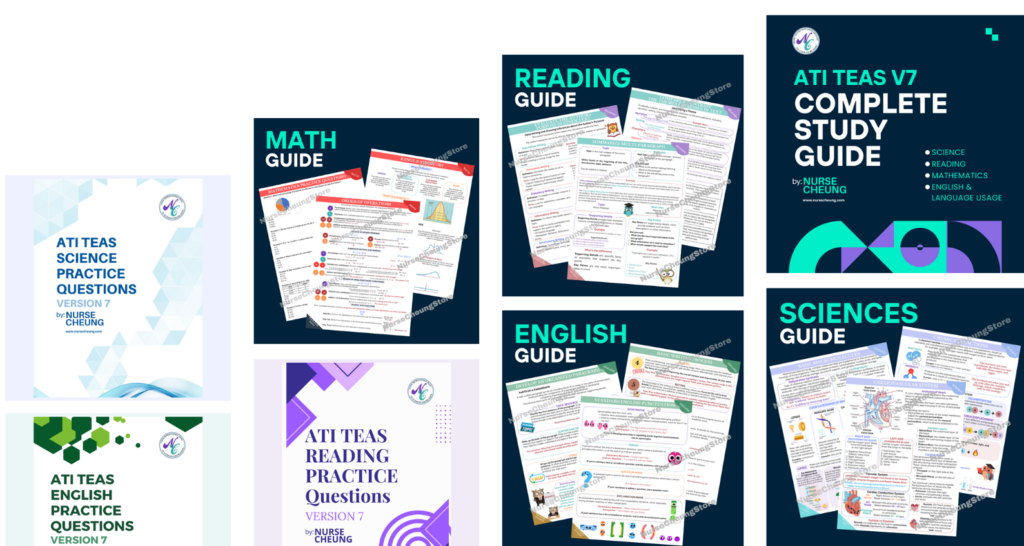
I have spent the last 10 years taking the confusion out of the TEAS and nursing school prep. Stop using overwhelming textbooks and start studying the exact, high-yield concepts that actually appear on the exam. Download the beautifully illustrated Complete TEAS 7 Study Guide today to get the visual breakdowns you actually need.
And when you secure that passing score, I want to make sure you are ready to apply these exact study habits to nursing school so you don’t fail your first clinical rotation. Join our live Mastermind for Nursing School Readiness and Beyond. This 6-week bootcamp is designed to build your foundation, featuring dedicated days exclusively covering Time Management, Core Class Breakdown for your entire nursing school journey, Clinical Prep, and Simulation Prep. We then bring it all together by making Week 6 strictly an NCLEX Style Prep to master answering nursing school and board-style questions.