

Decoding Your Official ATI TEAS 7 Score Report
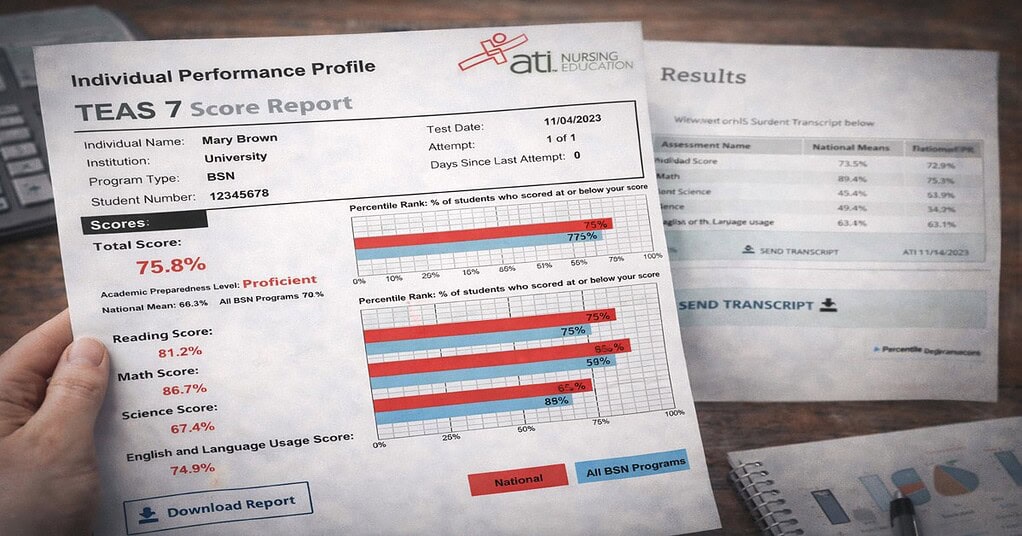
To read your ATI TEAS 7 score report, you must understand that your total composite score is a weighted calculation, not a simple average. The exam is weighted by subject: Science (29%), Reading (26%), Math (23%), and English (22%). Nursing admissions committees will look closely at your Academic Preparedness Level, as well as how your score compares to the National Mean and your specific Program Mean.
You just survived the grueling 3.5-hour marathon, clicked “submit” with shaking hands, and suddenly… a chaotic page full of percentages, percentiles, and academic jargon pops up on your screen.
If you are staring at your ATI score report and have absolutely no idea what “Program Mean” or “Academic Preparedness Level” actually means for your nursing school chances, take a deep breath. Let’s decode your official ATI TEAS 7 score report together so you know exactly where you stand with admissions—and exactly what to study if you need to retake it.
The Weighted Math (Why Science Hurts the Most)
Many students look at their four sectional scores, add them together, divide by four, and assume that gives them their final score. Let me break the bad news: that math is completely wrong.
The ATI TEAS 7 composite score is a weighted calculation. Not all sections are created equal, meaning some subjects carry a much heavier burden on your final grade. Here is the exact breakdown:
Science: 29%
Reading: 26%
Math: 23%
English: 22%
Because Science makes up the largest chunk of the exam, a bad science score will drag your entire composite score down much faster than a bad English score. You cannot bomb the complex Anatomy and Physiology questions and expect a high overall average to save you.
National Mean vs. Program Mean
When you look at your score report, you will see your performance compared against two different averages. It is crucial to know the difference between them:
National Mean: This is the average score of every single person who took the ATI TEAS 7 across the entire country, regardless of what degree or program they are pursuing.
Program Mean: This is the average score of students applying to the exact same degree type as you (BSN vs. ADN vs. PN).
Listen closely: The Program Mean is the one that actually matters to your university! You are competing against the applicants in your specific program tier for a limited number of clinical seats, so that is the benchmark you realistically need to beat.
The Sectional Minimum Trap
We need to talk about a harsh reality of nursing school admissions. Even if your weighted Composite Score is a fantastic 80%, you are not necessarily safe.
If your Math score is a 60% and your target nursing school strictly requires a 65% in every individual section, your application will likely be rejected. You will have to retake the entire exam. Admissions committees look for well-rounded applicants, so you cannot let a massive score in Reading hide a failing score in Math.
Your Action Plan for Retakes and Admissions
If your score report just revealed a massive weak spot in Science or Math, do not panic. You do not need to reread a heavy, 500-page textbook; you need targeted, visual study strategies to fix the exact concepts you missed.
Download the beautifully illustrated Complete TEAS 7 Study Guide today to fix your exact weak points and pull those individual section scores up.
And to ensure you bring this analytical, strategic mindset into your first semester, join our 6-week Mastermind for Nursing School Readiness and Beyond. We skip the fluff and dedicate specific days strictly to Time Management, Core Class Breakdown, Clinical Prep, and Simulation Prep, completely wrapping up the program by making week 6 a dedicated NCLEX Style Prep.