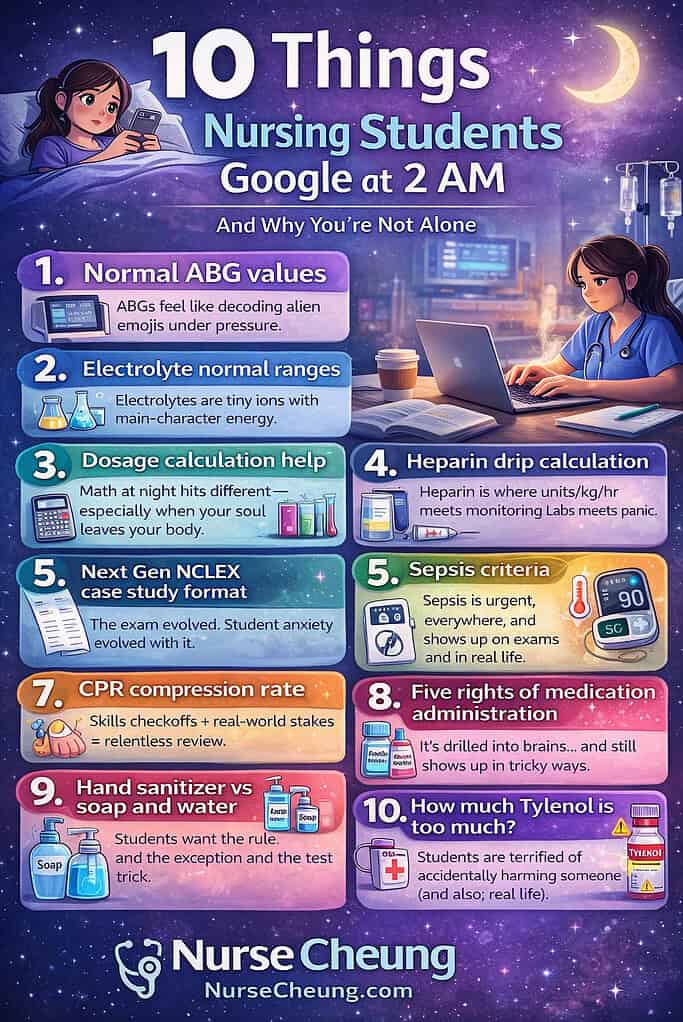
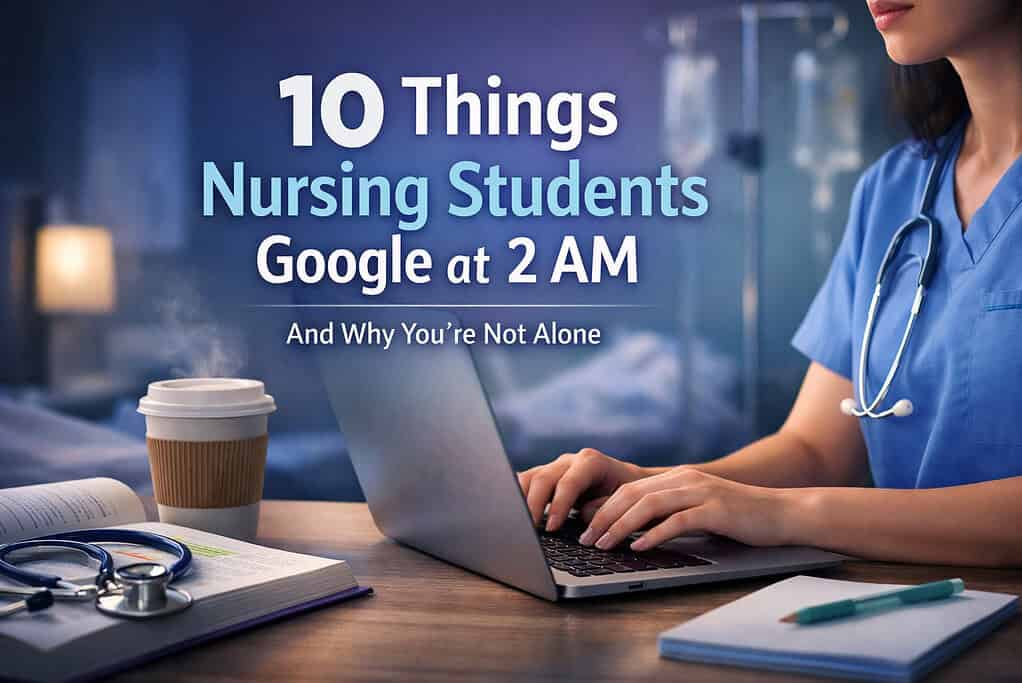
It’s 2:03 AM.
Your alarm is set for clinicals. Your coffee from earlier is cold. Your notes are highlighted in five different colors that no longer mean anything. And somehow—somehow—your brain has chosen this exact moment to remember that ABGs, heparin drips, and sepsis criteria exist.
So you do what millions of nursing students before you have done.
You open Google.
If you’ve ever found yourself searching nursing concepts in the middle of the night, this post is for you. Not because you’re behind. Not because you’re “bad at nursing.” But because nursing school is intense, high-stakes, and designed to stretch how your brain thinks.
Let’s talk about the 10 things nursing students Google at 2 AM, why they happen, and what they actually say about you as a future nurse.
Why Nursing Students Become Night-Time Google Scholars
Nursing school doesn’t just teach information—it teaches clinical judgment under pressure. That’s a very different kind of learning than memorizing facts for a multiple-choice test.
At night, when distractions fade and anxiety creeps in, your brain starts replaying questions like:
What if I mess this up on the exam?
What if I miss something important in clinical?
What if I hurt a patient someday?
That pressure has a name: cognitive overload. When your brain is juggling pathophysiology, medications, lab values, and expectations all at once, it looks for reassurance. Google becomes the safety net.
These late-night searches aren’t a failure. They’re a sign that you care—and that you’re learning how to think like a nurse.
The 2 AM Google Hall of Fame: What Nursing Students Search Most
1. “Normal ABG values”
ABGs are the final boss of nursing exams.
At 2 AM, ABGs feel like a secret code designed to humble confident students. You remember there’s a normal pH range, something about CO₂, and bicarbonate definitely matters—but the details feel fuzzy.
What students are really afraid of isn’t memorizing numbers. It’s misinterpreting a patient’s status.
The truth? ABGs are about patterns, not perfection. pH tells you acid or base. CO₂ points to the lungs. HCO₃⁻ points to the kidneys. Once you stop treating ABGs like random numbers and start treating them like a story, they become manageable—even at 2 AM.
2. “Electrolyte normal ranges”
Electrolytes are tiny ions with massive consequences.
Sodium affects the brain. Potassium affects the heart. Calcium affects muscles. Magnesium affects… everything, apparently.
At night, students panic because electrolyte questions feel deceptively simple—and brutally unforgiving. One wrong number can mean seizures, arrhythmias, or respiratory failure.
What’s really happening is that your brain is learning prioritization. Nursing exams don’t test whether you can memorize a chart. They test whether you understand what goes wrong when levels go wrong.
If you remember what each electrolyte controls, the numbers stop feeling so scary.
3. “Dosage calculation help before I cry”
There is no anxiety quite like math anxiety mixed with patient safety.
Dosage calculations show up in nursing school as a gatekeeper skill. Students don’t fear the math—they fear the consequences of being wrong.
At 2 AM, your Google search isn’t about decimals. It’s about responsibility.
The key concept most students eventually realize is that dosage calculations are logic problems, not math problems. Dimensional analysis works because it forces you to think step-by-step, cancel units, and slow down. When units make sense, the answer usually does too.
4. “Heparin drip calculation example”
Weight-based drips introduce a whole new level of stress.
Units per kilogram per hour. Lab monitoring. Titration protocols. One medication, many moving parts.
At night, students search heparin examples because they want reassurance that they understand the process, not just the formula.
Heparin isn’t about speed. It’s about safety. When you understand why weight matters and why labs guide dosing, the calculation becomes less intimidating—and more meaningful.
5. “Next Gen NCLEX case study format”
The Next Gen NCLEX changed the rules—and anxiety followed.
Students Google NGN at night because uncertainty is exhausting. Traditional exams rewarded memorization. NGN rewards clinical reasoning.
What helps most is realizing this: NGN isn’t trying to trick you. It’s asking you to think the way nurses actually think—assess, analyze, prioritize, and evaluate.
If you can explain why an answer makes sense, you’re already doing what NGN wants.
6. “Sepsis criteria I can remember under pressure”
Sepsis searches happen at night because sepsis is time-sensitive.
Students worry about missing it—on exams and in real life. The definitions feel complex, and the stakes feel enormous.
What helps is shifting from rigid criteria to trend recognition. Changes in mental status. Rising respiratory rate. Dropping blood pressure. Sepsis announces itself quietly before it screams.
Recognizing that pattern is what makes you a safe nurse.
7. “CPR compression rate”
No matter how many times you learn CPR, your brain still checks.
That’s not weakness—it’s respect for the skill.
CPR questions come with emotional weight. They remind students that someday, this knowledge won’t be theoretical.
At 2 AM, Googling CPR isn’t about numbers. It’s about responsibility. High-quality CPR isn’t perfection. It’s strong compressions, correct depth, and minimal interruptions.
8. “Five rights of medication administration”
The five rights are drilled into every nursing student’s brain—and still searched at night.
Why? Because students know medication errors can happen even when you “do everything right.”
What often gets missed is that medication safety is system-based, not just checklist-based. Interruptions, unclear orders, similar packaging—these matter too.
The five rights are a foundation, not a shield. Understanding that makes you safer, not weaker.
9. “Hand sanitizer vs soap and water”
This is a classic test-trap search.
Students know hand hygiene matters, but exams love exceptions. At night, you’re trying to remember when sanitizer isn’t enough.
The rule is simple: if hands are visibly soiled or certain organisms are involved, soap and water win. Context matters more than memorization.
10. “How much Tylenol is too much?”
This search happens because students realize something unsettling: common medications can still be dangerous.
Acetaminophen hides in combination products. It’s easy to exceed safe limits accidentally.
At night, students aren’t just studying—they’re protecting future patients. That awareness is a sign you’re becoming a nurse, not just a test-taker.
What These Searches Really Say About You
They say you care.
They say you’re thinking beyond grades and toward patient safety. They say your brain is shifting from memorization to responsibility.
Anxiety in nursing school often shows up right before growth. The discomfort you feel is your thinking expanding.
How to Study So You Google Less at 2 AM
You may never stop Googling completely—but you can reduce the panic.
Focus on:
Concepts over lists
Patterns over numbers
“Why” over “what”
And remember: sleep is not optional. A rested brain retains more, reasons better, and panics less.
From 2 AM Googling to Confident Nursing Practice
Every nurse you admire once Googled these same questions.
Late-night searching doesn’t mean you’re failing. It means you’re learning something that matters.
One day, you’ll realize you haven’t Googled ABGs in months. One day, a student will ask you these questions. And one day, someone’s safety will benefit from the care you took—even at 2 AM.
If this post made you feel seen, share it with a nursing bestie. Bookmark it for reassurance. And come back when your brain decides 2 AM is the perfect time to remember electrolytes again.
You’re not alone—and you’re becoming exactly the kind of nurse the profession needs.