
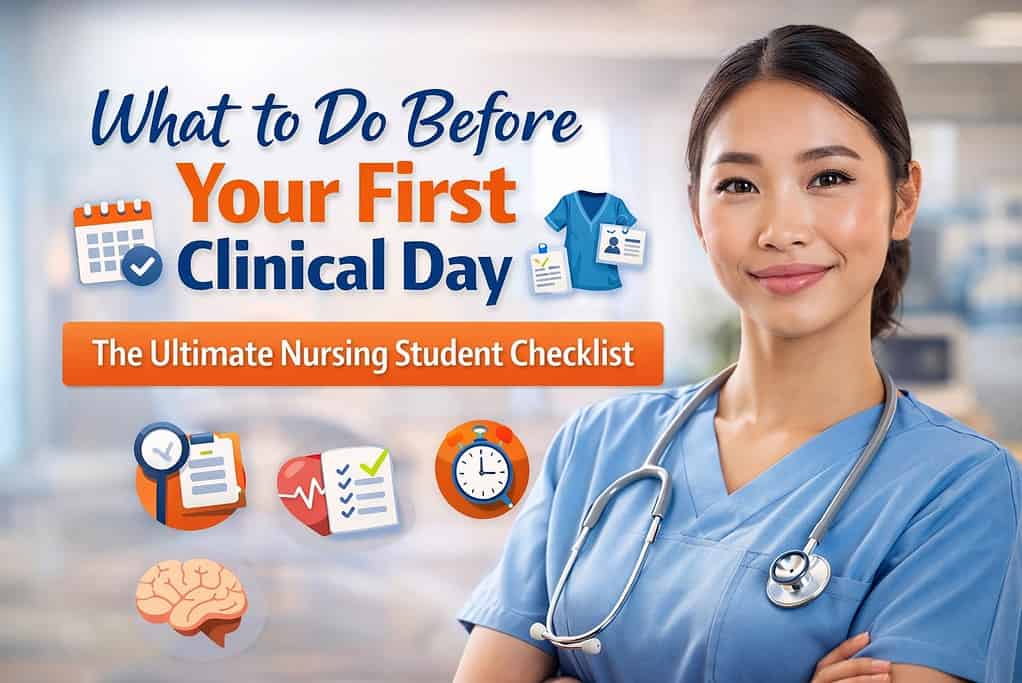

Your first clinical day is one of those moments that feels big—because it is. It’s the day nursing school stops being theoretical and starts becoming real. You’re no longer just memorizing lab values or practicing skills on mannequins. You’re stepping into a healthcare environment with real patients, real nurses, and real expectations.
Exciting? Absolutely. Nerve-wracking? Also yes.
The good news is this: confidence in clinicals doesn’t come from knowing everything—it comes from being prepared. Preparation lowers anxiety, sharpens focus, and allows you to show up calm, professional, and ready to learn.
This guide walks you through exactly what to do before your first clinical day, using a clear, practical checklist designed specifically for nursing students. Bookmark this post, share it with your cohort, and come back to it before every clinical rotation.
Why Preparation Matters Before Your First Clinical
Many nursing students assume clinical anxiety comes from a lack of knowledge. In reality, most first-day nerves come from uncertainty:
What should I wear?
What do I bring?
What if I forget something important?
What if I make a mistake?
Preparation answers those questions before you walk through the door.
When you take time to prepare properly, you:
Reduce cognitive overload on clinical day
Make stronger first impressions
Learn more because you’re less stressed
Build trust with instructors and staff
Start developing professional habits early
Think of preparation as your first nursing skill—it sets the tone for everything else.
Confirm All Clinical Details (Do This First)
Before you pack a single item, make sure you know the logistics of your clinical day. This sounds obvious, but it’s one of the most common areas where students make avoidable mistakes.
Confirm the following:
Clinical site name and exact address
Unit or floor assignment (if provided)
Start time and arrival time (these are often different)
Instructor name and meeting location
Parking instructions or badge requirements
Dress code specifics for that site
Write these details down. Save them in your phone. Screenshot the email. Redundancy is your friend.
Arriving early and oriented communicates professionalism before you ever say a word.
Prepare Your Uniform the Night Before
Your uniform is part of your professional identity. The night before clinical is not the time to discover your scrubs are wrinkled, stained, or missing.
Checklist for uniform prep:
Clean, wrinkle-free scrubs
Properly fitted (not too tight, not baggy)
School-approved color and style
Closed-toe, clean nursing shoes
Required socks (often white or neutral)
Name badge (clean and readable)
Avoid strong perfumes or colognes. Keep makeup minimal. Hair should be neat and secured if long. Nails should be short and clean, without artificial nails if prohibited.
Your goal is simple: look polished, hygienic, and ready to work.
Gather Your Clinical Supplies
Walking into clinical unprepared adds unnecessary stress. You don’t need everything—but you do need the essentials.
Common clinical day essentials include:
Stethoscope
Penlight
Watch with a second hand
Black pens (bring more than one)
Small notebook or clinical worksheet
Alcohol wipes (if allowed)
Hand sanitizer
Bandage scissors (if required)
Pack these items the night before in a designated clinical bag. Knowing exactly where everything is allows you to focus on learning instead of scrambling.
Review Skills You’re Likely to Perform
You are not expected to be perfect on your first clinical day. You are expected to have reviewed foundational skills.
Spend time refreshing:
Vital signs (manual BP, pulse, respirations)
Hand hygiene steps
PPE donning and doffing
Patient identification protocols
Basic communication techniques
Intake and output measurements
You’re not studying to perform flawlessly—you’re studying to feel oriented. Familiarity creates confidence.
Review Patient Safety Fundamentals
Patient safety is the backbone of nursing practice. Clinical instructors care far more about safe behavior than speed or advanced knowledge.
Before clinical, review:
The rights of medication administration
Fall precautions
Infection control principles
HIPAA and patient privacy
Proper body mechanics
Understanding safety expectations helps you avoid errors and builds trust with your instructor.
Understand Your Role as a Student Nurse
One of the most overlooked aspects of first clinical day preparation is mindset.
You are not there to:
Impress everyone with knowledge
Know how to do everything
Act like a licensed nurse
You are there to:
Learn
Observe
Ask questions
Practice safely under supervision
Be professional and respectful
Clinical is not a performance—it’s an apprenticeship. Curiosity and humility matter more than confidence without foundation.
Prepare Mentally and Emotionally
First clinical days can be emotionally intense. You may see illness, pain, fear, or even death for the first time in a professional setting.
Mental preparation matters.
The night before:
Get adequate sleep
Eat a balanced meal
Avoid cramming late into the night
Set realistic expectations for yourself
Remind yourself that discomfort is part of growth. Feeling nervous does not mean you’re unprepared—it means you care.
Plan Your Morning Strategically
Clinical mornings are not normal mornings. Build in buffer time.
Morning checklist:
Wake up early
Eat breakfast (even something small)
Hydrate
Double-check supplies
Review location and parking
Leave earlier than necessary
Rushing increases anxiety. Calm mornings lead to calm clinical performance.
Know How to Introduce Yourself
You will introduce yourself many times on your first clinical day—to instructors, nurses, patients, and staff.
Practice a simple, professional introduction:
“Hi, my name is ___, and I’m a nursing student working with your care team today.”
Clear, respectful communication builds trust immediately.
Set Learning Goals (Keep Them Simple)
Instead of overwhelming yourself with everything you want to learn, choose one or two goals for your first day.
Examples:
Perform vital signs confidently
Practice therapeutic communication
Observe medication administration
Learn unit routines
Small goals make progress measurable and satisfying.
Common First Clinical Day Mistakes to Avoid
Knowing what not to do is just as important.
Avoid:
Showing up late
Using your phone unnecessarily
Acting disengaged
Comparing yourself to others
Being afraid to ask questions
Taking feedback personally
Clinical instructors expect mistakes—they don’t expect unsafe or unprofessional behavior.
What to Do After Your First Clinical Day
Preparation doesn’t end when clinical does.
After your shift:
Reflect on what went well
Write down questions that came up
Review feedback from your instructor
Identify one thing to improve next time
Rest and recharge
Reflection turns experience into growth.
Final Thoughts: You’re More Ready Than You Think
Your first clinical day is not about proving yourself—it’s about beginning the journey of becoming a nurse.
Preparation gives you stability. Curiosity gives you growth. Compassion gives you purpose.
Use this checklist not just for your first clinical, but as a framework for every rotation ahead. The habits you build now will shape the nurse you become later.
And remember: every confident nurse you see today once stood exactly where you are now—nervous, hopeful, and learning one step at a time.
Bookmark this checklist. Share it with a classmate. Come back before your next clinical day.
Preparation is powerful—and you’re doing it right.