
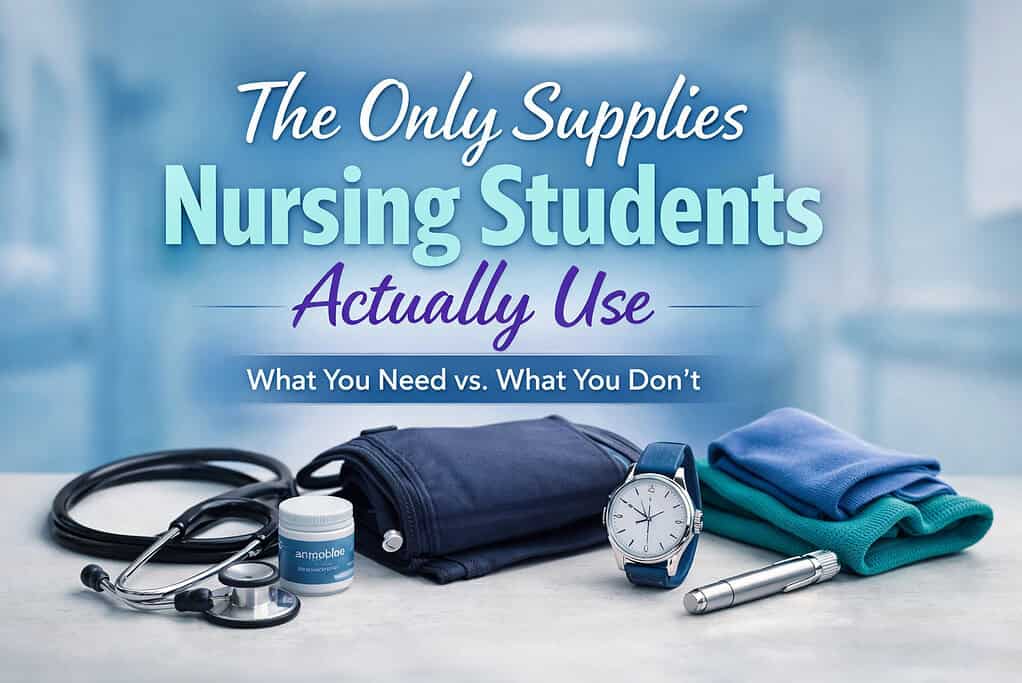
(What You Need, What’s Optional, and What You’ll Probably Never Touch)
If you’ve ever stared at your nursing school supply list and thought, “Do I really need all of this?”—you’re not alone.
Between school checklists, TikTok haul videos, and well-meaning advice from friends and family, nursing students often feel pressured to buy everything before the first day of class. The result? Hundreds of dollars spent on supplies that rarely leave the bag, while the truly important items get overlooked.
Here’s the truth no one says out loud: most nursing students use far fewer supplies than they expect. Nursing school is demanding, but it doesn’t require turning your backpack into a mobile hospital.
This guide breaks down the only supplies nursing students actually use, what’s optional, what’s often a waste of money, and how to build a smart, minimal kit that supports learning—not stress.
Why Nursing Students Overbuy (And Why It Makes Sense)
Nursing school is intense before it even starts. You’re stepping into a high-stakes profession where mistakes matter, expectations are high, and imposter syndrome sneaks in early.
Overbuying happens because:
School supply lists often combine required, recommended, and situational items without explanation
Social media promotes aesthetic nurse bags instead of functional ones
Anxiety convinces students that being “over-prepared” is safer than being under-prepared
Buying more supplies feels like control in an uncertain situation. But preparation isn’t about quantity—it’s about relevance.
So let’s get clear on what actually gets used in real clinical settings.
The Non-Negotiables: Supplies Nursing Students Use Weekly
These are the items that consistently show up in clinicals, labs, and skills check-offs. If you invest anywhere, invest here.
1. A Stethoscope (and Cleaning Wipes)
A stethoscope is the most frequently used tool in nursing school. You’ll use it for:
Lung sounds
Heart sounds
Apical pulse
Manual blood pressures
It does not need to be the most expensive model on the market. What matters is that it works reliably and you know how to use it.
What does matter is hygiene. Stethoscopes are a known source of bacterial contamination, which is why infection prevention matters. According to the Centers for Disease Control and Prevention, healthcare-associated infections affect roughly 1 in 31 hospitalized patients on any given day. Keeping simple alcohol wipes with your stethoscope isn’t overkill—it’s basic professional practice.
Bottom line: Buy one good stethoscope. Clean it regularly. You’ll use it constantly.
2. A Watch With a Second Hand (or Approved Timer)
This is one of the most underestimated essentials in nursing school.
You need a visible second hand to:
Count respirations accurately
Measure pulse rate
Perform timed skills during check-offs
Many nursing programs explicitly require a watch with a second hand because phones and smart devices may not be allowed during clinicals. Even when digital timers are permitted, having a physical backup saves stress.
Bottom line: Simple, functional, and frequently required.
3. A Penlight
A penlight may seem basic, but it’s used more often than students expect. It’s essential for:
Neurological checks (pupil response, PERRLA)
Wound inspection
Assessments in dim patient rooms
Pupil assessment is a standard part of nursing evaluations, supported by clinical guidance from institutions like the Cleveland Clinic.
Bottom line: Inexpensive, lightweight, and actually useful.
4. Manual Blood Pressure Cuff (Program-Dependent but Common)
Even though many hospitals rely on automated machines, nursing education still emphasizes manual blood pressure skills.
Manual BP measurement is often tested in:
Skills labs
Practical exams
Competency check-offs
Educational resources from the National Center for Biotechnology Information outline manual BP as a foundational nursing skill using a cuff and stethoscope.
Some programs provide cuffs, while others require students to purchase their own. Always check your syllabus before buying.
Bottom line: If required, you’ll use it repeatedly early on.
5. Clinical-Approved Shoes That Protect Your Body
Nursing students walk and stand far more than they expect. Research shows nurses average thousands of steps per shift, and studies of nursing students report extremely high rates of foot discomfort.
Shoes matter because:
Clinical shifts can last 8–12 hours
Poor footwear contributes to foot, knee, and back pain
Many schools enforce strict footwear rules (closed-toe, non-slip, low heel)
Comfort isn’t a luxury—it’s injury prevention.
Bottom line: Invest in shoes that meet clinical requirements and support long hours.
Comfort & Survival Supplies (Optional but High-Return)
These aren’t always required, but many students swear by them once clinicals begin.
Compression Socks
Long periods of standing contribute to leg fatigue and swelling. Occupational health research supports compression stockings for workers who stand for extended periods, noting reduced discomfort and edema.
For nursing students, compression socks can:
Reduce leg fatigue
Improve comfort during long shifts
Support circulation
They’re not mandatory, but many students wish they’d tried them sooner.
Minimal Personal Care Items
Think functional, not aesthetic:
Lip balm (hospital air is dry)
Unscented hand lotion
Hair ties or clips
Skip anything bulky or scented. Less is more.
The Hidden Costs That Aren’t Really “Supplies”
This is where many students feel blindsided.
Beyond physical items, nursing school includes mandatory expenses such as:
Background checks and drug screening
Immunizations and titers
CPR/BLS certification
Uniforms, badges, and lab fees
These costs are commonly listed on nursing program websites and can add up quickly. They’re not glamorous, but they’re unavoidable.
Planning for these early prevents financial stress later.
Situational Supplies: Only Buy If Required
Some items are useful only in specific programs or rotations. Buying them early often leads to regret.
Examples include:
Trauma shears
Large foldable clipboards
Specialty tools like tuning forks
These may be helpful in certain settings—but unnecessary in others. If your instructor hasn’t explicitly required it, wait.
What Most Nursing Students Regret Buying
After the first semester, many students realize they overbought. Common regrets include:
Multiple stethoscope accessories
Oversized clipboards that don’t fit in clinical spaces
Carrying full textbooks to clinicals
More items mean:
More clutter
More contamination risk
More mental load
Infection prevention principles emphasized by the Centers for Disease Control and Prevention support minimizing unnecessary items that move between environments.
How to Build a Smart, Minimal Nursing Student Supply Kit
Before buying anything, ask yourself:
Will I use this weekly?
Is it explicitly required by my program?
Does it help me assess, document, protect myself, or physically survive the shift?
If the answer is no, pause.
A well-prepared nursing student isn’t the one with the biggest bag—it’s the one who knows how to use the essentials well.
Buy Less, Stress Less, Learn More
Nursing school is hard enough without financial regret and clutter weighing you down.
Most nursing students need fewer supplies than they think, but they need the right ones. By focusing on functional essentials, understanding program requirements, and resisting social media pressure, you can save money, reduce stress, and show up ready to learn.
Before you buy anything, double-check your syllabus—and save this guide. Chances are, you’ll come back to it more than once.