
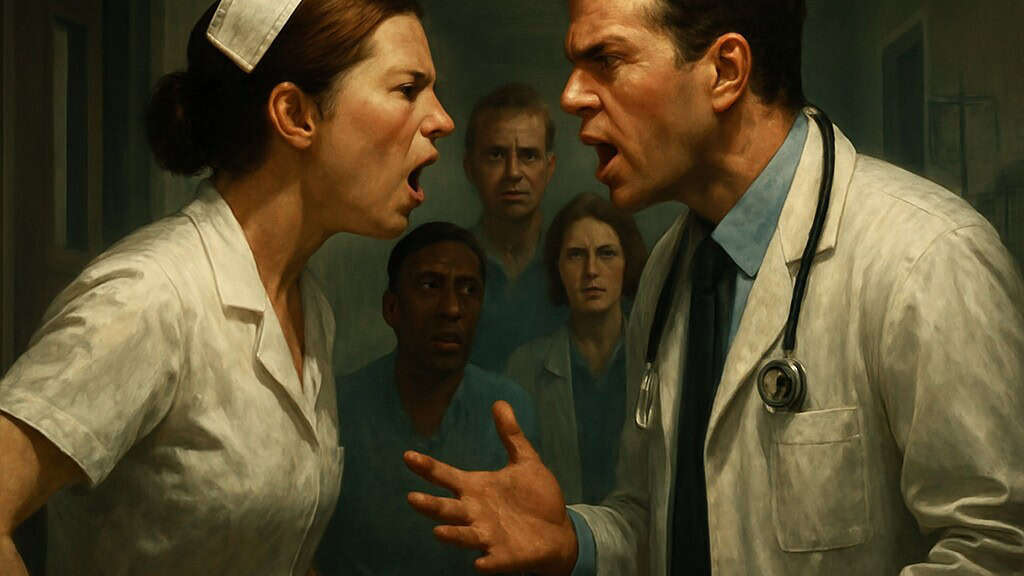

It’s 2:13 a.m.
You’re on the unit. Your patient doesn’t look right. Vitals are trending the wrong way. Something feels off—not “textbook emergency,” but that quiet, gut-level alarm nurses know too well.
So you page the resident.
The response comes back:
“Ok. Recheck in the morning.”
No bedside visit. No orders. No follow-up questions.
And just like that, the tension starts simmering.
If you’ve worked in a hospital for more than five minutes, you’ve seen it. Felt it. Maybe even been part of it. The unspoken, sometimes explosive friction between nurses and residents. The side-eye. The clipped messages. The internal monologue of “Do they even understand what I’m dealing with right now?”
People like to brush this off as “just workplace drama” or blame it on personalities—“that resident is arrogant,” “that nurse is difficult.” But here’s the uncomfortable truth:
This beef isn’t about attitude.
It’s about systems.
And it matters more than most people realize.
Because when communication breaks down between nurses and residents, patient safety is the first thing at risk.
Let’s Call It What It Is: This Isn’t a Personality Problem
The internet loves a good “nurses vs residents” narrative. TikToks. Memes. Vent posts. Hot takes.
But boiling this down to ego misses the bigger picture.
Most nurses aren’t trying to be “difficult.”
Most residents aren’t trying to be dismissive.
What is happening is a predictable collision of:
High-stress environments
Sleep deprivation
Hierarchy
Different training models
Overloaded systems
And human beings doing their best inside all of that
Healthcare runs on teamwork in theory—but in practice, it often runs on pressure, speed, and hierarchy. When those forces collide, tension isn’t a failure. It’s a symptom.
Two Jobs, Two Brains, One Patient
To understand the conflict, you have to understand how differently nurses and residents are trained to think.
The Nursing Brain: Continuity and Pattern Recognition
Nurses live in the continuum of patient care.
You don’t just see a potassium of 3.4.
You see:
The patient who’s been trending down all shift
The diuretic they’re on
The subtle change in mental status
The monitor alarms that aren’t quite alarming… yet
Nursing practice is built on pattern recognition and early detection. You’re trained to notice what’s about to go wrong, not just what’s wrong right now.
And when something goes sideways, nurses are often the ones physically present—managing the fallout in real time.
The Resident Brain: Decision Authority Under Cognitive Load
Residents, especially interns and cross-covering residents, live in a very different reality.
They’re:
Covering multiple units
Managing dozens of patients they may have never met
Fielding nonstop pages
Making decisions under time pressure
Often running on minimal sleep
Residents are trained to prioritize, triage, and make decisions based on protocols, thresholds, and efficiency. They’re managing risk at scale.
So when a nurse says, “Something feels wrong,” and a resident asks for objective data or delays action, it’s not always dismissal—it’s triage logic under cognitive overload.
Same patient.
Different lenses.
Why the Conflict Always Peaks at Night
If the nurse-resident beef had a favorite shift, it would be nights.
Here’s why.
Night shift strips healthcare down to its bare bones:
Fewer staff
Less immediate backup
Higher patient-to-provider ratios
More cross-coverage
Residents covering nights are often responsible for patients outside their primary service. Nurses, meanwhile, are providing continuous care to the same patients hour after hour.
This creates a perfect storm:
Nurses see trends
Residents see snapshots
Nurses feel urgency
Residents feel bandwidth constraints
So when a nurse pages about a concern that doesn’t meet a textbook threshold, it can feel brushed off. And when residents receive multiple pages that all feel “urgent,” it can feel overwhelming.
Neither side is wrong—but both feel unheard.
Burnout Turns Small Friction Into Full-Blown Conflict
Burnout doesn’t just make people tired.
It changes how the brain functions.
High levels of burnout are associated with:
Reduced empathy
Shorter patience
Impaired decision-making
Increased irritability
Nurses and residents are both experiencing high rates of burnout—often simultaneously, often invisibly.
That’s why:
Neutral messages feel rude
Clarifying questions feel like challenges
Stressful interactions escalate faster than they should
What might have been a calm conversation on a well-staffed day becomes a full-blown conflict when everyone is running on empty.
This doesn’t excuse poor behavior—but it does explain why it happens so often.
The Hierarchy Problem Nobody Wants to Say Out Loud
Healthcare says it values teamwork.
But it still operates on hierarchy.
Residents hold medical decision-making authority.
Nurses hold bedside knowledge and implementation power.
That imbalance affects communication—especially when things get tense.
Nurses may hesitate to escalate concerns for fear of being labeled “difficult” or not getting what they need.
Residents may interpret pushback as a challenge to their authority.
The result?
Information gets delayed
Concerns get minimized
Safety signals get missed
Hierarchy isn’t just about titles—it’s about who feels safe speaking up. And when people don’t feel safe, patients pay the price.
When the Beef Becomes a Patient Safety Issue
This is where the conversation has to shift.
Because nurse-resident conflict isn’t just uncomfortable—it’s dangerous when left unchecked.
Breakdowns in communication have been linked to:
Delayed interventions
Missed assessments
Medication errors
Adverse patient outcomes
When tension silences voices or discourages collaboration, early warning signs get lost. And in healthcare, timing matters.
This isn’t about who’s right.
It’s about what keeps patients safe.
The Fix Isn’t “Be Nicer” (Here’s What Actually Helps)
elling stressed clinicians to “just communicate better” is useless. The solution isn’t politeness—it’s structure.
1. Shared Communication Frameworks
Tools like SBAR (Situation, Background, Assessment, Recommendation) work—not because they’re perfect, but because they give everyone a shared language.
They:
Reduce ambiguity
Lower emotional friction
Focus conversations on action
When both nurses and residents use the same framework, fewer messages get lost in translation.
2. Closed-Loop Communication
Repeating back plans and confirming understanding sounds simple—but it prevents more errors than most people realize.
“Just to confirm, we’re rechecking labs in two hours and calling if X happens.”
That single sentence saves time, confusion, and resentment.
3. Clear Escalation Pathways
When nurses know exactly how and when to escalate concerns—and residents know those pathways are supported by leadership—conflict decreases.
Ambiguity breeds tension. Clarity diffuses it.
Nurses and Residents Aren’t Enemies—They’re Trapped in the Same System
This might be the hardest truth to swallow.
The real problem isn’t nurses.
It’s not residents.
It’s not even communication skills.
It’s a system that:
Overworks its staff
Normalizes burnout
Relies on heroics instead of support
Treats conflict as a personal failure instead of a design flaw
Nurses and residents are on the same side—whether it feels like it or not.
Both care about patients.
Both are stretched thin.
Both are doing critical work under impossible conditions.
Conclusion: The Beef Is Real—but It’s Not Inevitable
Yes, the nurse-resident tension is real.
Yes, it’s frustrating.
Yes, it deserves to be talked about.
But framing it as drama misses the opportunity to fix what actually matters.
When we stop blaming individuals and start examining systems—communication structures, workload, hierarchy, burnout—we move closer to safer care and healthier teams.
So the next time that tension flares up, ask a different question:
“What is this system making us fight over—and how do we change it?”
If this resonated with you, share it with a nurse or resident who’s felt this tension firsthand. These conversations don’t weaken healthcare—they make it stronger.
Because at the end of the shift, the real goal isn’t winning the argument.
It’s getting everyone home safe—including the patient.