

Most people think kidneys have one job: make urine.
That’s like saying your phone exists only to tell time.
Your kidneys are among the hardest-working organs in your body. They run quietly in the background, filtering blood, balancing chemicals, managing fluids, producing hormones, and keeping your internal environment stable—every minute of every day. You don’t feel them working. You don’t hear them complain. And because they’re so efficient, they’re easy to overlook.
Until something goes wrong.
Understanding what your kidneys actually do—beyond “making pee”—changes how you think about hydration, blood pressure, medications, chronic disease, and long-term health. Let’s take a walk through a typical day in the life of your kidneys and see what these two fist-sized organs are really up to.
The Morning Shift: Filtering Your Blood Without a Break
Your kidneys start working before you wake up—and they never stop.
Every minute, a large portion of your blood flows through them. Inside each kidney are about a million tiny filtering units called nephrons. Each nephron contains a microscopic filter that screens blood and a winding system of tubules that decide what stays and what goes.
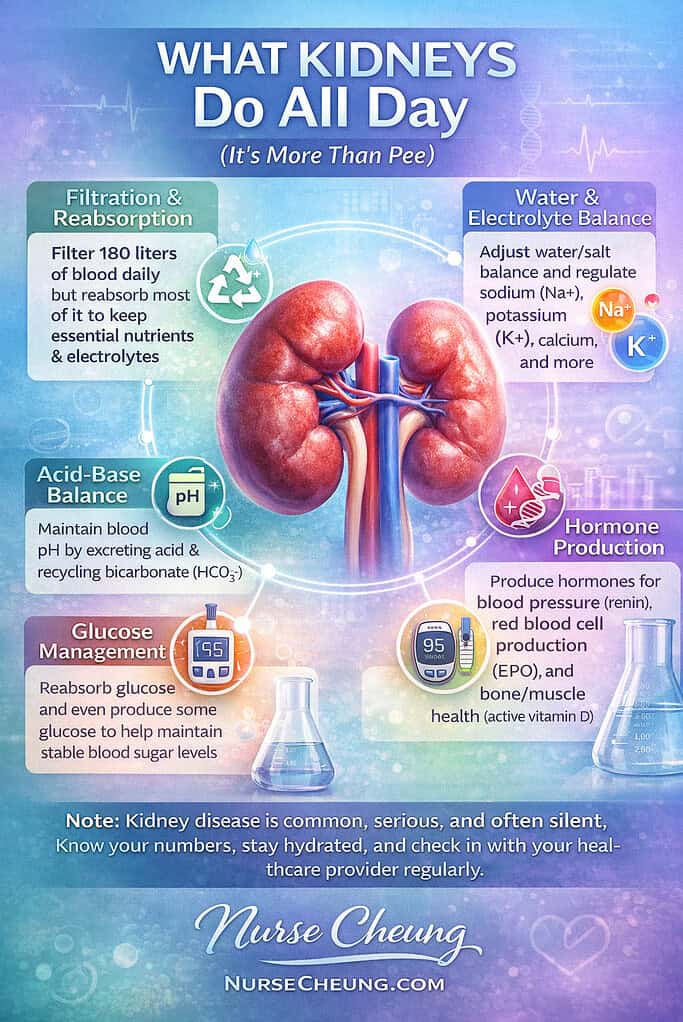
Here’s the surprising part: your kidneys don’t just filter out waste and dump everything else. They filter almost everything and then carefully reclaim what your body still needs.
Water. Sodium. Glucose. Amino acids. Bicarbonate.
Think of your kidneys less like a coffee filter and more like a highly advanced recycling facility. They pull in raw material, sort it at high speed, discard toxins, and return valuable resources back to circulation.
Over the course of a single day, your kidneys generate an enormous amount of filtered fluid—yet only a small fraction leaves your body as urine. The rest is reabsorbed with remarkable precision. That’s why healthy kidneys can maintain balance even when your diet, activity level, or hydration status changes.
The Balancing Act: Water, Salt, and Electrolytes
Ever notice how your urine looks darker when you’re dehydrated and lighter when you drink a lot of water?
That’s your kidneys adjusting in real time.
One of their most important jobs is fluid and electrolyte balance. They constantly monitor how much water and salt your body has and fine-tune urine concentration accordingly.
When you’re low on fluids, your kidneys conserve water by making urine more concentrated. When you’re well hydrated, they release excess water to keep your blood chemistry stable. Sodium, potassium, calcium, and phosphate are also tightly regulated because even small shifts can affect nerve signals, muscle contractions, and heart rhythm.
This balancing act explains why intense sweating, diarrhea, vomiting, or high-salt meals can throw your body off—and why kidney function is so critical during illness. Without healthy kidneys, these internal adjustments become difficult or impossible.
The pH Guardians: Keeping Your Blood Chemistry Stable
Your blood needs to stay within a very narrow pH range to function properly. Too acidic or too alkaline, and vital enzymes, proteins, and cellular processes start to fail.
Your lungs help regulate pH by controlling carbon dioxide levels. Your kidneys handle the long game.
They manage acid–base balance by adjusting how much bicarbonate (a natural buffer) is reclaimed and how much acid is excreted in urine. This process happens quietly over hours to days and is essential for long-term stability.
That’s why kidney problems can lead to dangerous shifts in acid–base balance—and why symptoms like fatigue, confusion, and shortness of breath can appear when this system breaks down. You may never consciously think about pH, but your kidneys are constantly working to keep it exactly where it needs to be.
The Hormone Factory Nobody Talks About
Here’s a fact that surprises many people: kidneys are endocrine organs.
They don’t just respond to hormones—they produce them. And these hormones affect your entire body.
Blood Pressure Control
Your kidneys help regulate long-term blood pressure by releasing a hormone that influences blood vessel tone and fluid retention. When kidney signaling is disrupted, blood pressure often follows.
Red Blood Cell Production
Healthy kidneys release a hormone that tells your bone marrow to make red blood cells. When kidney function declines, this signal weakens, leading to anemia. That’s why people with chronic kidney disease often feel tired, weak, or short of breath.
Bone and Vitamin D Health
Your kidneys activate vitamin D into its usable form. Without this activation, calcium balance suffers, and bone strength declines. Kidney disease can quietly undermine bone health long before fractures appear.
These hormone functions explain why kidney problems rarely stay confined to the urinary system. They ripple outward, affecting blood pressure, oxygen delivery, and skeletal integrity.
The Glucose Manager: Kidneys and Blood Sugar
Most people associate blood sugar control with the pancreas and liver. But your kidneys play a surprisingly important role here too.
As blood is filtered, glucose enters the kidney tubules right along with everything else. In healthy kidneys, nearly all of that glucose is reabsorbed and returned to circulation. That’s why glucose normally doesn’t appear in urine.
When blood sugar levels rise too high, or when kidney transport systems are overwhelmed or intentionally blocked by medication, glucose spills into urine. This mechanism has become a therapeutic target in modern diabetes care, highlighting how central the kidneys are to metabolic balance.
The kidneys also contribute to glucose production during fasting, acting as a backup system to help keep blood sugar stable when dietary intake is low.
Clearing Medications and Toxins: Why Kidney Function Matters So Much
Many medications—and their byproducts—are cleared through the kidneys. This happens through a combination of filtration and active secretion in the tubules.
When kidney function declines, drugs can accumulate to unsafe levels unless doses are adjusted. That’s why healthcare providers pay close attention to kidney function when prescribing antibiotics, pain medications, contrast dyes, and many chronic therapies.
This also explains why dehydration, illness, or certain supplements can suddenly make medications feel “too strong.” The kidneys aren’t failing—they’re struggling to keep up with an increased workload.
When the System Breaks Quietly: The Hidden Risk of Kidney Disease
One of the most dangerous aspects of kidney disease is how silent it can be.
Early kidney damage often causes no pain and no obvious symptoms. Many people don’t realize there’s a problem until significant function has already been lost. By the time fatigue, swelling, or changes in urination appear, the damage may be advanced.
Chronic kidney disease affects millions of adults, and most don’t know they have it. High blood pressure, diabetes, heart disease, and long-term medication use all increase risk. Because kidneys compensate so well, routine blood and urine tests are often the only way to detect problems early.
The takeaway isn’t fear—it’s awareness. Kidney disease isn’t inevitable, but ignoring kidney health makes it easier to miss.
The Big Picture: Two Small Organs Doing a Lifetime of Work
Your kidneys filter blood, balance fluids, regulate electrolytes, stabilize pH, produce hormones, manage glucose, and clear toxins—all day, every day, without asking for attention.
Urine is just the visible output. The real work happens upstream.
Caring for your kidneys means caring for hydration, blood pressure, blood sugar, and medication safety. It means paying attention to routine labs and not brushing off “mild” abnormalities. It means respecting organs that quietly support nearly every system in your body.
Your kidneys may not demand much from you—but they do a remarkable amount for you.
If this article changed how you think about kidney function, share it with someone who still believes kidneys only make pee. And if you want more clear, science-based explanations of how your body actually works, this is just the beginning.