
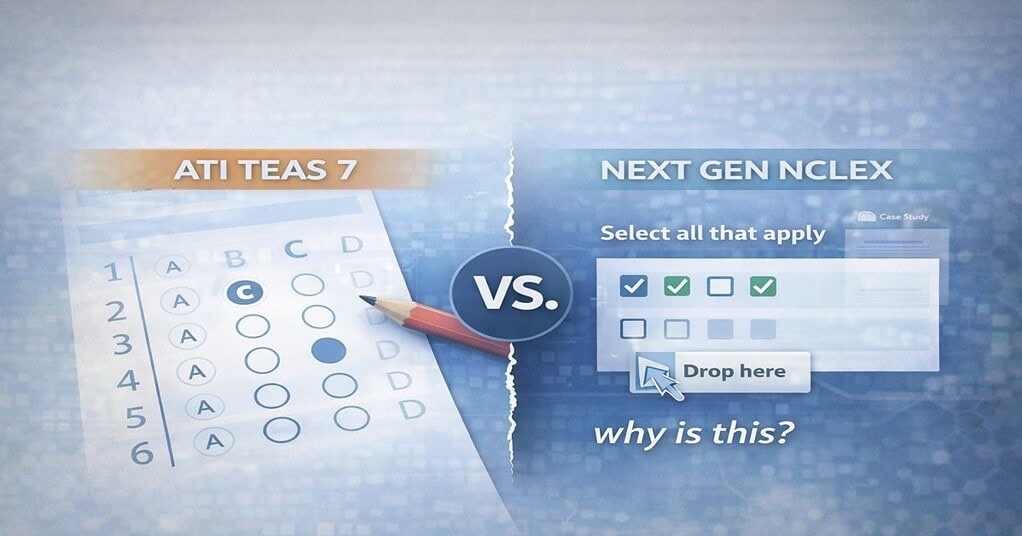

While Alternate Item Types (like Select All That Apply) make up a maximum of 15% of the ATI TEAS 7 exam, they are the number one cause of test-day panic. ATI added these Next-Generation question formats to mirror the NCLEX, ensuring incoming nursing students possess foundational clinical judgment. Do not let 15% of the exam destroy your confidence for the other 85%.
The Blueprint Shift: More Than Just a Hurdle
The ATI TEAS 7 was intentionally updated to include Alternate Item Types, such as Select All That Apply (SATA) and Ordered Response questions, to directly mirror the format of the Next Generation NCLEX (NGN). Mastering these question types early on the TEAS ensures that nursing students develop the critical thinking and clinical judgment skills required to pass their final board exams.
The Evolution: Why the TEAS 6 Was Retired
If you speak to older nurses, they will tell you the TEAS entrance exam used to be entirely standard, four-option multiple-choice questions. That was the TEAS 6.
However, the nursing profession realized that traditional multiple-choice questions do not accurately measure a nurse’s ability to make safe, real-time decisions at the bedside. Therefore, the National Council of State Boards of Nursing (NCSBN) completely overhauled the licensing board exams, launching the Next Generation NCLEX to heavily test “clinical judgment.”
Because the NCLEX evolved, the entrance exam had to evolve with it. ATI upgraded to the TEAS 7 to ensure that the students being admitted to nursing programs actually possessed the foundational critical thinking required to survive the new NGN formats.
The Shared DNA: SATA & Hot Spots
The alternate item types you see on the TEAS 7 are the exact same mechanics you will face on the NCLEX.
When you encounter a Select All That Apply (SATA) question on the TEAS Science section, you cannot just guess. You must evaluate every single option independently using the “True/False Isolation Method.” This is the exact same mental framework you will use during your Pharmacology exams in nursing school to safely administer medications without harming a patient.
Similarly, Ordered Response questions (drag-and-drop) on the TEAS train your brain to prioritize sequences. On the TEAS, you might be ordering the steps of the scientific method. On the NCLEX, you will be ordering the steps of a sterile dressing change. The content changes, but the clinical judgment remains exactly the same.
The 15% Panic Spiral
Here is the reality: Alternate Item Types only make up about 15% of your total exam. The vast majority of the TEAS 7 is still traditional multiple-choice.
However, because these Next-Gen questions carry so much psychological weight, students hit one SATA question, panic, and let that anxiety bleed into the rest of their test. They lose focus, rush through standard multiple-choice questions they actually know the answers to, and ultimately destroy their overall score.
You need to stop viewing this 15% as a trap, and start viewing it as your very first nursing school class. The mechanics you use to solve these questions are the exact same mechanics you will use to safely administer medications as a nurse. Keep your composure, lean on your test-taking strategies, and do not let 15% of the exam dictate your final score.
The Educator's Promise
As a Master’s prepared Nurse Educator (MSN, RN), my goal is not just to help you pass a single entrance exam. My goal is to build your clinical operating system so you can transition seamlessly from pre-nursing student, to clinical rockstar, to a fully licensed Registered Nurse. We learn to think like a nurse on day one.
Stop Memorizing, Start Thinking
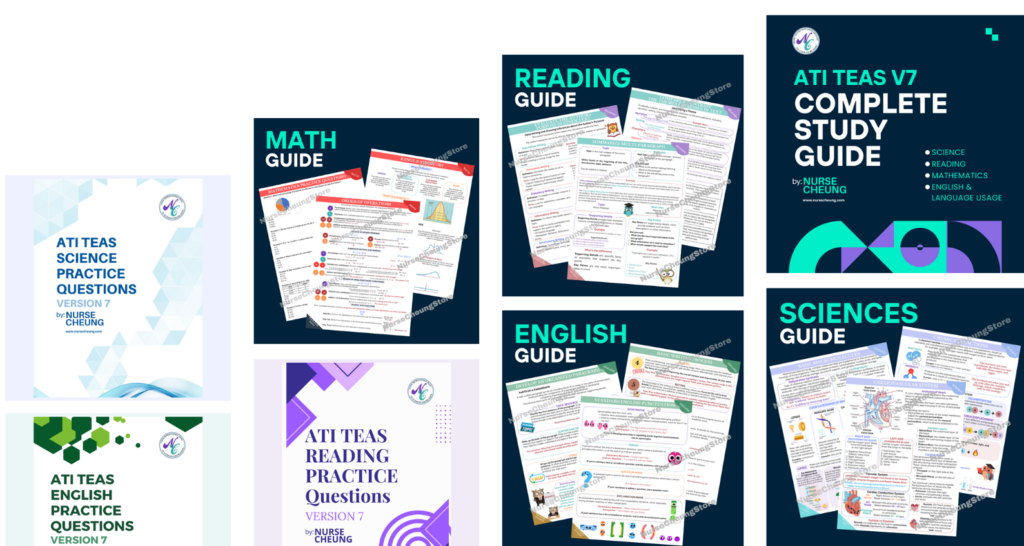
Don’t just memorize facts to pass a test; learn how to think like a nurse. Master the Next-Gen question formats today with the visual frameworks inside our Complete TEAS 7 Study Guide.
And to guarantee your transition from pre-nursing to clinical practice is absolutely seamless, join our 6-Week Mastermind for Nursing School Readiness. Week 6 is entirely dedicated to the NCLEX Decoder, ensuring you walk into your first semester lightyears ahead of your classmates.