


If you’ve taken the ATI TEAS—or you’re preparing to retake it—you already know this uncomfortable truth: studying harder doesn’t always mean scoring higher.
Many students spend weeks rereading notes, highlighting textbooks, watching endless videos, and sacrificing sleep—only to see a score stuck in the 60s. The frustration is real. You know you’re capable. You’ve put in the time. Yet when the results appear, they don’t reflect your effort.
Here’s the reality most students don’t hear early enough: ATI TEAS success is not about effort alone. It’s about having the right system.
Students who move their scores from the 60s into the 80s aren’t magically smarter. They aren’t lucky test-takers. They simply stop studying randomly and start following a structured, data-driven study system—one designed specifically for how the ATI TEAS actually works.
This post breaks down the exact study system used by Nurse Cheung students who consistently improve their scores. No generic tips. No overwhelming theory. Just a clear, repeatable framework you can follow with confidence.
Why Most ATI TEAS Study Plans Fail (Even for Smart Students)
Before we talk about what works, we need to be honest about what doesn’t.
Most ATI TEAS study plans fail because they rely on passive studying and guesswork.
Students often:
Study everything instead of targeting weaknesses
Reread notes instead of testing their understanding
Watch videos without applying the information
Cram days before the exam
Use no schedule, no structure, and no feedback loop
These habits feel productive. They’re familiar. They’re comfortable. But they don’t force the brain to retrieve, apply, and refine knowledge—which is what standardized exams like the ATI TEAS require.
The result? False confidence during studying, followed by disappointment on test day.
The problem isn’t intelligence. The problem isn’t motivation.
The problem is the absence of a system.
The Philosophy Behind the Nurse Cheung Study System
The Nurse Cheung study system is built on one guiding principle:
Scores improve when studying becomes intentional, targeted, and repeatable.
Instead of asking, “What should I study today?”
The system answers:
What matters most?
What am I weakest in?
What gives me the biggest score return for my time?
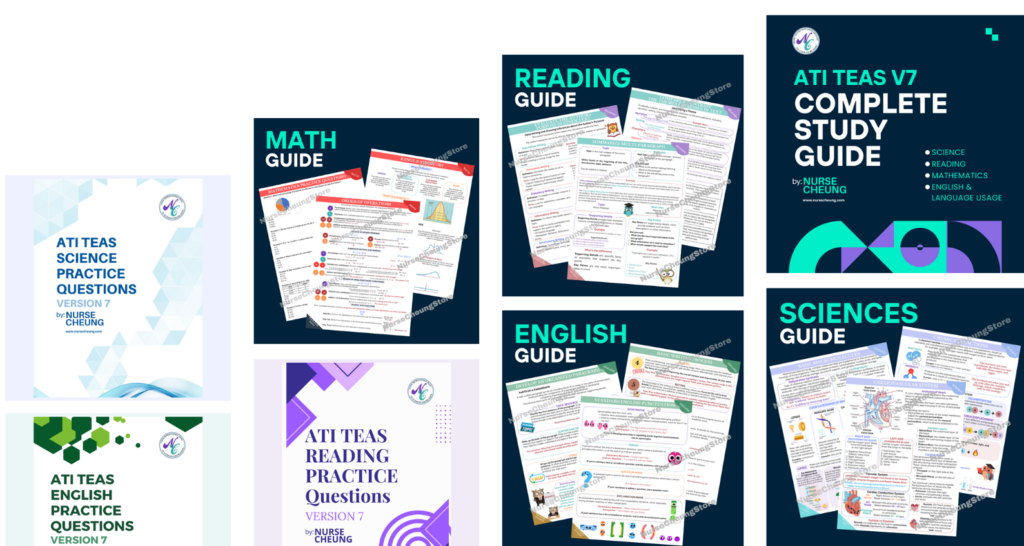
This framework replaces chaos with clarity. Every Nurse Cheung resource—planners, practice questions, workshops, and guides—fits into a single unified system, not scattered prep.
The process follows a simple loop:
Diagnose → Train → Repeat → Perform
Once students commit to this cycle, score growth becomes predictable instead of hopeful.
Step 1: Diagnose Your Weaknesses Using ATI Data (Not Guesswork)
One of the biggest mistakes students make is studying based on feelings instead of facts.
“I think I’m bad at science.”
“I feel like math is my problem.”
Feelings are unreliable. ATI TEAS data is not.
ATI score reports break performance down into:
Overall score
Subject scores
Sub-content areas
This is gold—if you know how to use it.
The Nurse Cheung system teaches students to:
Identify their lowest sub-content areas, not just subjects
Rank weaknesses by point potential
Ignore strengths temporarily and focus on what’s leaking points
Instead of “studying the TEAS,” students begin studying their specific gaps.
This alone saves hours of wasted effort and immediately increases efficiency.
Step 2: Learn With Intention—Then Immediately Test
Here’s a hard truth most students resist at first:
If you aren’t testing yourself, you aren’t really studying.
Passive learning creates familiarity, not mastery. The Nurse Cheung system flips the script by making practice questions the main event, not an afterthought.
The learning loop looks like this:
Learn a focused concept using Nurse Cheung content
Immediately complete practice questions on that topic
Review rationales—especially incorrect answers
Log mistakes and patterns
Retest later
This forces the brain to retrieve information, confront misunderstandings, and correct errors in real time.
Students often realize they thought they understood something—until the questions exposed gaps. That moment of discomfort is where real learning happens.
Step 3: Use a Structured Study Schedule That Prevents Cramming
Motivation fades. Systems don’t.
Many students fail not because they don’t study—but because they study inconsistently.
The Nurse Cheung study planner removes decision fatigue by answering:
What to study
When to study
How long to study
When to review
Instead of asking “What should I do today?”, students follow a clear roadmap.
The planner:
Breaks content into manageable daily sessions
Builds in review days automatically
Prevents last-minute cramming
Encourages consistency over intensity
This structure creates momentum. Even on low-energy days, students know exactly what to do—and that consistency compounds.
Step 4: Rotate Subjects to Build Real Test Readiness
The ATI TEAS doesn’t test subjects in isolation. Your studying shouldn’t either.
Many students study one subject for weeks, then switch—only to feel overwhelmed when everything appears mixed together on test day.
The Nurse Cheung system introduces intentional subject rotation once foundations are built.
This means:
Studying math, science, English, and reading within the same week
Mixing question types gradually
Training the brain to switch gears efficiently
This mirrors real test conditions and builds confidence. Students stop panicking when questions change topics because their brain has practiced adapting.
Step 5: Weekly Checkpoints That Force Score Growth
Without feedback, studying becomes guessing.
Every Nurse Cheung study plan includes weekly checkpoints—timed practice sets that act as truth checks.
These checkpoints help students:
Measure progress objectively
Identify recurring mistakes
Adjust focus before small gaps become big problems
Track timing and endurance
Many students keep a simple “miss log” to record:
What went wrong
Why it went wrong
What to review next
This transforms mistakes into strategy instead of discouragement.
Step 6: Test-Day Execution—Where Scores Are Won or Lost
Some students don’t need more content.
They need fewer unforced errors.
Test anxiety, poor pacing, and second-guessing can sabotage even well-prepared students.
The Nurse Cheung system prepares students for execution, not just knowledge.
This includes:
Pacing rules for each section
Strategies for difficult or unfamiliar questions
Guessing rules to avoid paralysis
Mental reset techniques when anxiety spikes
Confidence isn’t something you “hope” shows up. It’s trained—just like content.
What This System Looks Like in Real Life
Students who raise their scores from the 60s to the 80s follow a pattern:
They stop collecting random resources
They commit to a structured plan
They prioritize practice over passive review
They track progress instead of guessing
They trust the process
Some improve in 30 days. Others take longer. The timeline varies—but the system stays the same.
The difference isn’t talent. It’s adherence.
Who This Study System Is (and Isn’t) For
This system is for students who:
Feel overwhelmed by the ATI TEAS
Have taken the exam before
Want a clear, step-by-step plan
Are willing to practice intentionally
It is not for:
Passive studiers
Shortcut seekers
Students unwilling to follow structure
Nurse Cheung doesn’t offer magic tricks. She offers mentorship, clarity, and a proven system.
Stop Guessing. Start Following a System.
If your ATI TEAS score is stuck, the solution isn’t studying longer hours or buying more resources.
The solution is changing how you study.
Students who move from the 60s to the 80s don’t rely on motivation alone. They rely on a system that tells them:
What to study
How to study
When to review
How to perform
The Nurse Cheung study system removes confusion, builds confidence, and turns effort into results.
Your next score doesn’t need luck.
It needs a plan.
And now—you have one.