


There’s a very specific moment when it happens. You’re standing in line somewhere—maybe for coffee, maybe at Target—and you catch yourself mentally prioritizing tasks the way you were taught in class. Airway, breathing, circulation… coffee. You look down and realize you’re wearing scrubs on your day off “because they’re comfortable.” You casually say something like, “I have clinical,” and expect everyone to understand why that means everything else is canceled.
That’s when it hits you.
You’re not thinking about nursing school anymore.
You’re in it.
Becoming a nursing student isn’t marked by a single dramatic event. It’s a gradual shift—mental, emotional, and logistical—where your habits, language, stress levels, and worldview quietly rearrange themselves around this profession. The signs show up in your schedule, your sleep, your conversations, and even the way you look at people in public.
This post breaks down the most common (and unmistakable) signs you’re officially a nursing student—not just for laughs, but to help you understand why these changes happen and what they actually mean about your growth. If you’ve been feeling overwhelmed, behind, or like nursing school has taken over your life, this is your reminder: you’re not failing. You’re becoming.
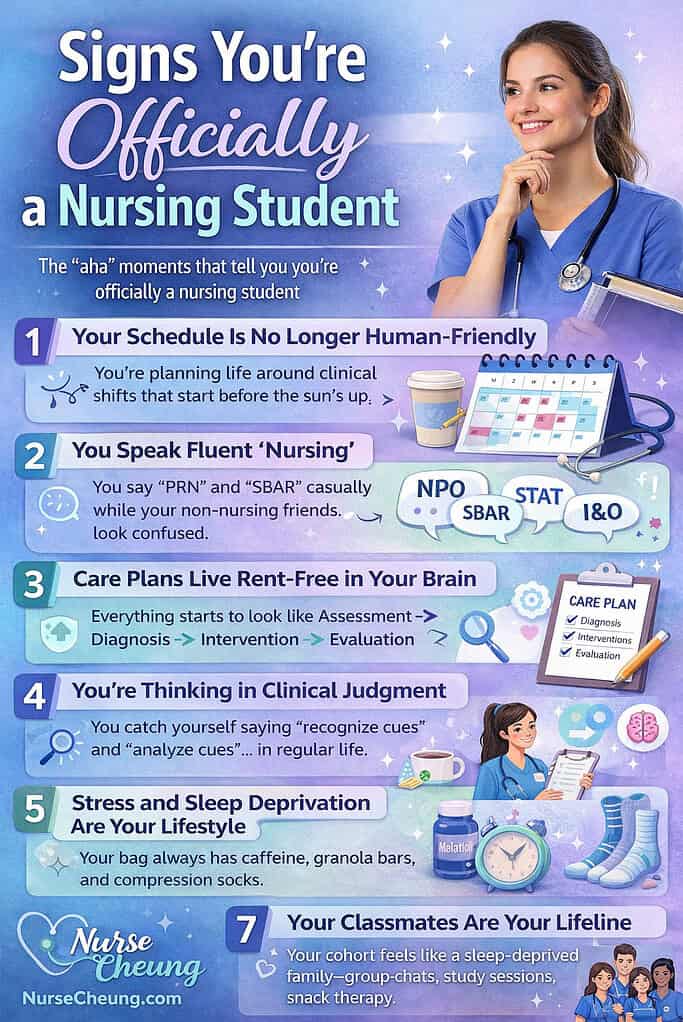
Sign #1: Your Schedule Is No Longer Human-Friendly
Before nursing school, time was something you managed. Now, time manages you.
Your calendar is filled with things like clinicals, pre-conference, post-conference, lab, skills check-offs, exams, group projects, and study blocks that somehow still feel insufficient. Early mornings become routine. Twelve-hour clinical days don’t even sound shocking anymore. You plan your week around syllabi, not social invitations.
This isn’t accidental.
Nursing programs intentionally structure schedules to mirror the realities of healthcare. Hospitals don’t run on convenience, and neither does nursing education. Learning to function early, late, tired, and under pressure is part of the training. Time management isn’t just a productivity skill—it’s a patient safety skill.
If your life feels scheduled down to the minute and still chaotic, that’s not a personal failure. It’s one of the clearest signs you’ve entered a professional training environment designed to stretch your capacity.
Sign #2: You Start Speaking Fluent “Nursing”
One day, you realize your vocabulary has changed.
You say things like “NPO,” “PRN,” “stat,” “I&O,” and “SBAR” without translating. You describe symptoms instead of feelings. You think in terms of assessments instead of assumptions. You might even catch yourself explaining everyday situations using clinical logic—much to the confusion of friends and family.
This shift in language isn’t about sounding smart. It’s about learning to think clearly and communicate safely.
In nursing, words matter. Precision matters. Structured communication frameworks exist because miscommunication costs lives. As a student, you’re learning to replace vague language with objective data, and emotional reactions with clinical reasoning. Over time, that way of thinking starts to spill into daily life.
When people around you stop understanding half of what you’re saying, that’s not isolation—it’s professional identity formation in progress.
Sign #3: Care Plans Live Rent-Free in Your Brain
Few things inspire collective groans among nursing students quite like care plans.
They’re time-consuming. They feel repetitive. They often seem disconnected from the fast-paced reality of actual patient care. And yet, somehow, they follow you everywhere. You start mentally identifying nursing diagnoses in real life. You prioritize tasks using interventions and outcomes. You evaluate how things “could have gone better” like it’s second nature.
Here’s the truth: care plans aren’t about paperwork. They’re about rewiring how you think.
Care plans force you to slow down and articulate your reasoning. They teach you to connect assessment findings to clinical decisions. They build the mental scaffolding that allows nurses to act quickly without cutting corners later on. Even when you never write one again after graduation, the thinking process stays with you.
If you’re frustrated by care plans, that’s a sign they’re doing their job.
Sign #4: You Can’t Unsee Clinical Judgment Anywhere
At some point, nursing school changes how your brain works.
You stop looking at situations as isolated events and start seeing patterns. You recognize cues. You anticipate outcomes. You think in priorities instead of possibilities. When something feels “off,” you can’t always explain why—but you know it matters.
This is clinical judgment developing.
Modern nursing education places heavy emphasis on decision-making, not memorization. You’re being trained to notice subtle changes, analyze incomplete information, and choose the safest action under pressure. That’s why exams feel different now. That’s why questions are layered and uncomfortable. That’s why “select all that apply” feels personal.
If you’re finding it harder to answer questions but easier to think like a nurse, you’re exactly where you’re supposed to be.
Sign #5: Stress, Sleep Deprivation, and Snack-Based Survival
Let’s be honest: nursing school is stressful.
Your sleep schedule is inconsistent. Your stress levels fluctuate wildly around exams and clinicals. You rely on caffeine, snacks, and sheer determination more often than you’d like to admit. Some days you feel confident and capable. Other days, you wonder if you belong at all.
This doesn’t mean you’re weak.
Nursing school combines high cognitive load, emotional exposure, time pressure, and performance evaluation—often all at once. You’re learning complex material while being assessed constantly, usually in environments where mistakes feel high-stakes. That kind of stress would challenge anyone.
The goal isn’t to pretend it’s easy. The goal is to recognize that stress is a response to demand, not a reflection of worth. Learning to manage it—through structure, support, and self-awareness—is part of becoming a safe, sustainable nurse.
Sign #6: Simulation and Check-Offs Feel Weirdly Serious
You know it’s a mannequin. You know it’s not real.
And yet, your heart rate spikes anyway.
Simulation labs and skills check-offs are some of the most emotionally intense parts of nursing school. Being watched, evaluated, timed, and corrected can feel brutal. One small mistake can make your mind go blank. Confidence disappears the moment someone holds a clipboard.
But there’s a reason for this environment.
Simulation creates a safe place to fail. It allows students to practice high-risk skills without harming real patients. It builds muscle memory, decision-making, and emotional regulation under pressure. The discomfort you feel now is preparation for moments later when real people depend on your calm response.
If simulation makes you nervous, it’s because you care—and that’s exactly what the profession requires.
Sign #7: You’ve Found “Your People”
Something unexpected happens in nursing school.
You bond quickly.
Your cohort becomes your support system—people who understand why you’re exhausted, why you’re stressed, and why a passing exam feels like winning the lottery. Group chats explode before exams. Study sessions turn into therapy sessions. Victories and failures are shared communally.
This sense of belonging isn’t incidental. Nursing is a team profession. Learning together mirrors how you’ll eventually work together. These relationships teach collaboration, accountability, and empathy in ways textbooks never could.
If your classmates feel like family—sometimes dysfunctional, always intense—that’s another sign you’re exactly where you belong.
The Bigger Picture: What These Signs Really Mean
Taken individually, these signs might feel like chaos.
Together, they tell a different story.
They show that your brain is adapting to complexity. That your identity is shifting from student to clinician. That you’re learning to manage responsibility, uncertainty, and pressure in a structured way. Nursing school isn’t just about acquiring knowledge—it’s about becoming someone who can be trusted with other people’s lives.
Growth rarely feels comfortable. Competence often develops quietly, underneath frustration and doubt. The very things making you question yourself are often the evidence that learning is happening.
You’re Not “Behind”—You’re Becoming
If you see yourself in these signs, take a breath.
You’re not failing because you’re tired.
You’re not incapable because you’re stressed.
You’re not behind because things feel hard.
You’re in the middle of a transformation that demands more than memorization—it demands resilience, judgment, and growth.
Nursing school changes you because nursing requires change. And one day, you’ll look back at this version of yourself—the one juggling schedules, care plans, simulation anxiety, and imposter syndrome—and recognize it for what it was.
The moment you became a nurse in progress.
If this post resonated with you, share it with someone in your cohort who needs the reminder. And remember: struggling doesn’t mean you don’t belong. Often, it means you’re right on track.